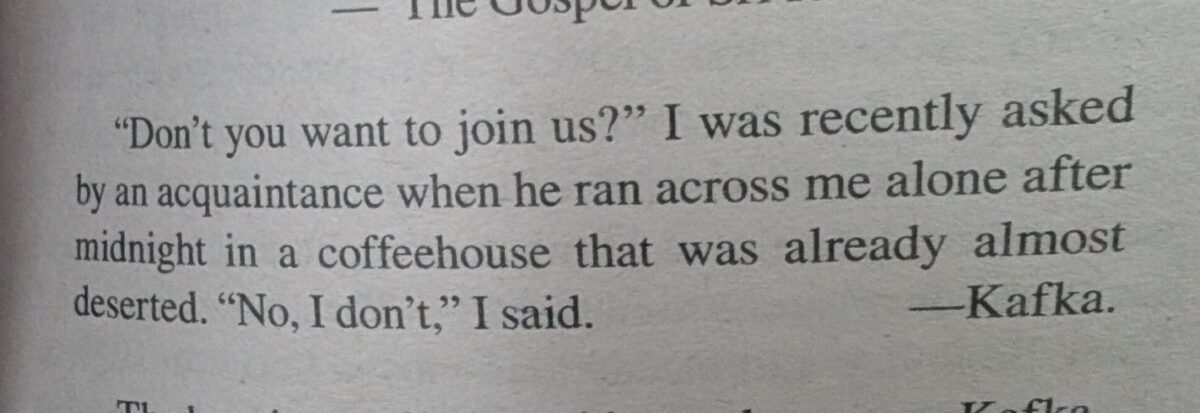
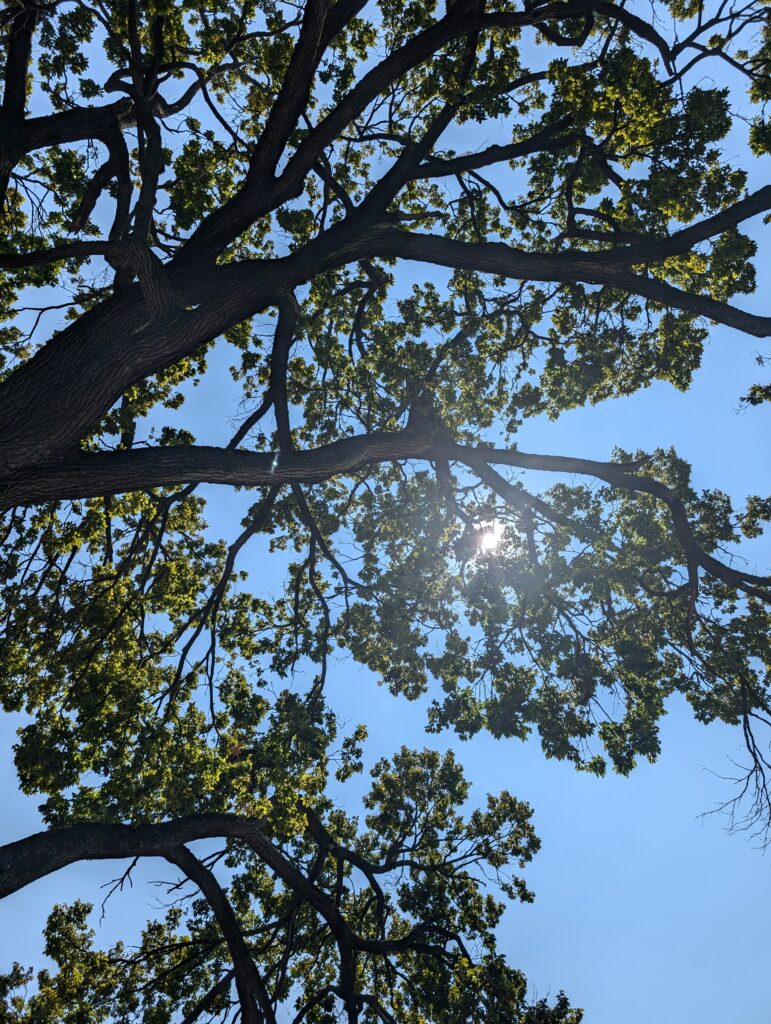
I noticed the sun because the tree was in the way.
When an opportunity knocks, do you peek through the curtain, expecting a puerile prank? Do you slide the deadbolt over for good measure? Or invite it over for tea?
All the scraps of writing I’ve been doing are loose sheets of paper on the floor. A mound of crumpled paper spills over the brim of a tin trash bin. It’s good to feel casual about an abandoned, unfinished book. Nothing is ever really complete, just abandoned. I sit here and make peace with the disorder, yielding to the process.
The dizzying meanderings of my life are now, in motion, reeling from one bad decision to the next, one exchange to another, and lessons that will only be learned too well and then forgotten. I accept the waywardness of life itself and remove my person suit to slip into moments instead. Celebrate the whims, the naivete, thwarted plans, and my bedraggled appearance. Bangs cut a bit too short, saying something and taking it back, and spilling over onto the floor. I draw stares and make a peep in a quiet crowd. I tell them, “I’m as surprised as you are.”
I stay passive without altering anything around me. This bigger idea of nonchalance lends itself to the richness of life.
I’ve avoided life, and now I’m walking back into it.
"Our proprioceptive and interoceptive systems are constantly talking, activating both involuntary and voluntary responses of the body. These reactions dictate our mood, our perception of the world, and our perception of ourselves."
The thing about nature is that it not only involves the trees and the sea, but people. The speed of traffic. The climate in between. The day in its entirety. In Indian philosophy, particularly Hinduism, it’s called Prakriti.
Energy does not only exist; it flows. It shuffles.
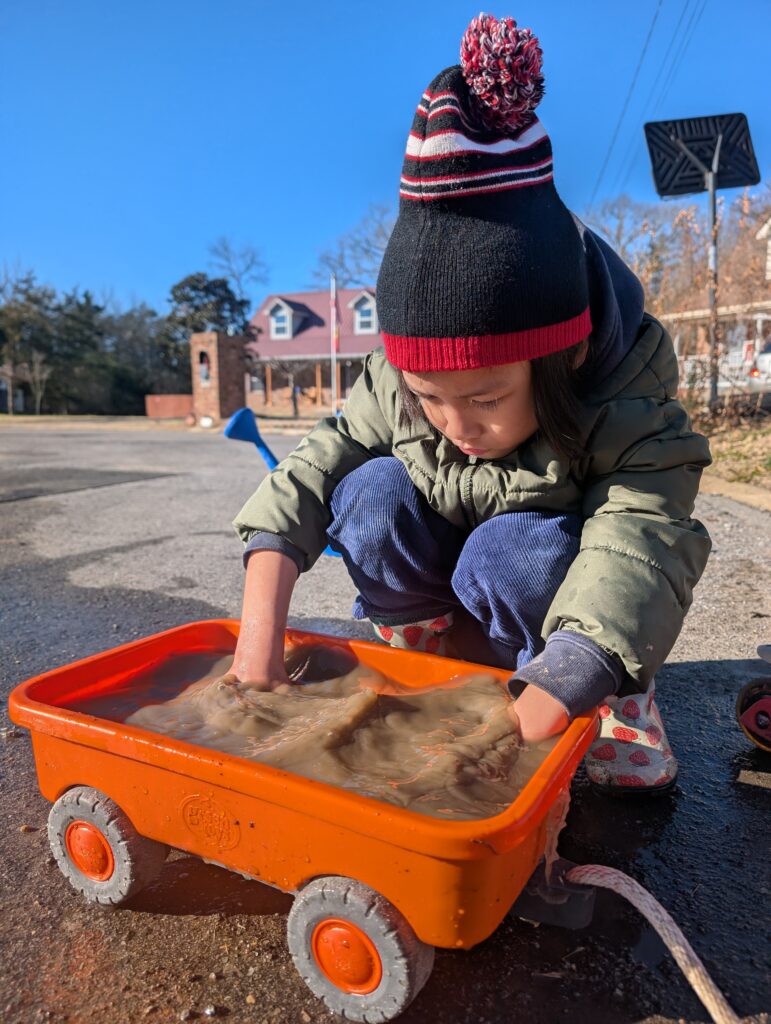
Jude’s concoction.
I look at mindfulness as an empirical study of thought and feeling. But the thoughts turn up unannounced. I hide in the coat closet on a frantic phone call to my husband as I yet again pluck him out of his daily toil.
“I spent the day puttering around the house, avoiding their menacing presence. I’m sorry, I’m sorry, go back to work,” I say.
I prefer finding that thought before it meets a feeling.
I am in a state of urgency, in this lost state of agency. There is a demand that needs meeting. I oscillate between two pairing thoughts, and I send text messages faster than I should, my boss asking me whether we need to talk.
“I was only recording my thoughts,” I say. “I did not have to involve you in it.”
A balancing scale sways up and down, softly pendulating, responding to two opposite forces before it can reach equilibrium. This is no different from the nervous system responding to a hyper-arousal state, or the body wobbling in a balancing yoga pose.
Here lies another day wasted, staring at a blank screen of an unfinished thing, of what will be another forgotten account I’m documenting.
I’ve been spending cold mornings with my dog, watching him play. Observing him as I try and write anything. I am weary, at a loss for words, mostly, and meaning, a compass spinning.
Any work I read by Anaïs Nin, I prepare myself. The house must be quiet, and the chores must be done. I dim the lights. A prefatory setting must be made as though I’m setting out my finest cutlery for her impending visit. I know I’ll spend a great deal of time on the corner section of the sofa, and I’ll have already chewed my fingernails to the point of tenderness.
on writing
I read her essay, “The New Woman,” retreating to the deep reflection of her senses that lured me in the first place. She wrote about why one writes, liking it to breathing. She wrote profusely about how writing allowed her to experience life twice.
Writing can help one become increasingly aware. In moments when a writer feels bound, writing can liberate and create more room.
on artists
Anaïs Nin lived through other artists, and not just those who draw, compose music or design architecture. In her essay, she broadens this representation to those trapped in the house of the creative spirit — those with ideas and wanting to share them; those who seek to embody their internal world and who still bear their child-like fantasies into adulthood. She believed the creative quality that manifests in one makes an artist. She adds that psychologists often validate what poets have spoken about long ago, following a quote by Freud, “Everywhere I go, I find a poet has been there before me.” Nin aspired to both men and women creatives, particularly Henry Miller, whom she esteemed for the writer he was and the context in which he wrote. “I think I saw Miller very clearly,” she said.
on the new woman
On “The New Woman,” Nin envisions the novel woman blossoming today. This woman is courageous and adventurous and harmonizes with her strength but is quiet about it. She rations sharing her growth and success. This woman is no longer homebound through chores while wearing an apron. Rather, this woman encourages the man to be a partner with her, not a provider, and a sensitive man, at that, not threatened or compromised by this new woman.
Women have served as muses for a long time, and Nin cleaved onto this desire to be this inspiration to avoid having to write herself. For years, women were not asked to be pushed into the direction of a great writer, doctor or philosopher, but to marry and raise children. This new woman, however, faces her trauma and fear, falls in love hopelessly, taps into her sensuality and explores the confusing world of her own neurosis.
Anaïs Nin and her psyche
In her complex framework, Nin finds poetry as essential as philosophy and psychology, which we lean into to recenter our misaligned selves. An artist rearranges herself to write fiction and dismantles herself to write her diaries, but the division is complementary and integrated. Her intuition sloshes along rationale without blending, like water and oil, and coexists when contained.
If you have read her diaries, you know she has delved into her vulnerabilities and explored her curiosities. Plunging into her psyche, one will come out soaked and disoriented from the depths of her perception. Nin does not highlight the disparity between women and men, femininity and masculinity. She blurs the lines, leading you to where the two converge. Where there is poetry, there is intellectuality. Where there is devastation, you will find creation.
In days when I’m confounded in my reverie, I look to Nin for having dreams and penchants. To assert myself. To have passion and communicate through the channel of emotion. To be moved by impulses and to stand rooted in personal conviction.
I’ve been reading about David Foster Wallace in Although Of Course You End Up Becoming Yourself by David Lipsky. It’s a book in a transcript/interview format that tells the exchange between Rollingstone reporter and editor David Lipsky and Infinite Jest author, David Foster Wallace. They take a road trip. They sit with his dogs. They confess. They tell and find common ground.
I am the backseat passenger, the customer behind two dudes in line engaging in brilliant conversations that consumes me. Like being on the outside looking in, being incredibly drawn even though I can’t keep up with every inside joke, every esteemed piece of literature.
So many profound little bits here, this one in particular. Wallace sheds some insight into how reviewers will use his “first book as a noose to hang” his second. He also mentions how authors can be easily displaced because of new authors or “better” works hitting the market.
Wallace, an introspective soul as human as they come, arrives with profound insight as a writer, as a writer tackling topics that confound him some that include but are not limited to fame, prestige or life in general. Especially here; I love how he articulates or sometimes struggles to articulate, given his thought-riddled messy cognition, how he doesn’t identify with “more talented” or “less talented” or if something is “shit.” Rather, he thinks, “Man, there might be something here, but I just don’t get it. This is just not my cup of tea.”
How refreshing! How easily someone can dismiss a piece of work that fails to get across, so they reach for the closest, easy to grab, sorry excuse they could find instead of reasoning and sympathizing with the artist.
Wallace’s response is genuine and thoughtful because as someone who’s too into himself, too inside his own mind, David knows and knows too well how it’s like to go through these waves, how the “envy stuff” just burned him and how that kind of mindset can tear you up. He doesn’t “wanna send any blood supply to that part” of his brain anymore.
To be revered for your work and to want more recognition, it’s a vicious cycle and everyone’s out competing in a saturated market for the same small slice of the pie.
“And it’s not like I’m above it. It’s just that it — the amount that it hurts me, outweighs whatever good feelings it gives me.”
Top 7 Movies Writers Should Watch by Rina Pritchard
Films have a way of inspiring us. While books, people and nature can open the minds of creators, movies hold an untouched charm to them, from their cinematography and screenplay to their overall theme.
Here’s my list of movies I think every writer should watch.
1. The End of the Tour
In March 1996, Rolling Stone magazine writer, David Lipsky, sets out to interview Infinite Jest novelist, David Foster Wallace. Wallace, played by Jason Segel, who hunkers down in Bloomington, Ill., participates in the five-day-long interview conducted by the overdetermined Lipsky, played by Jesse Eisenberg.
What this movie lacks in plot, makes up in character exploration. The dynamic between David Foster Wallace and David Lipsky is unreal, forcing us to pause the movie and sit back and say, “Oh, shit.” In this film, where an emotional connection is certainly felt, an intellectual connection is chucked to the back seat. Egotism is apparent but not regarding the Oxford comma. Writers experiencing inferiority or constant unfulfillment will get it.
2. Nocturnal Animals
A successful art gallery owner receives a book, written by her ex-husband. She is consumed by the compelling novel, a piece of genius that causes her to reevaluate her life and face her inauspicious reality.
Another movie writers should watch is Nocturnal Animals. Nocturnal Animals is filled with suspense, something we gobble up. If you’re interested in personal progression and telling others, “Yeah, I made it,” then I suggest this one. Writers who’ve been doubted by their closest peers will take comfort in the revenge in this film when even their dearest ones failed to root for them in their darkest corners.
3. The Words
Bradley Cooper steals another writer’s work and publishes it as his own.
It’s a good film to sit back and watch after pumping out 5,000 words from your last chapter. It has it all: writer’s block, literary plagiarism and inferiority. The Words is paramount to the world we live in today: how we can lose our voice for the sake of becoming someone idolized and esteemed in an era saturated with others like us.
4. Ruby Sparks
A character from Calvin Weir-Fields’ latest work comes alive. He soon learns that her feelings and actions are dictated by the words he writes on his typewriter.
Writers are everyone in their book—of course, we created them. We don’t have to find them in our kitchen making dinner for us to understand how real they are. Ruby Sparks is a delightful treat for authors who’ve ever wanted to meet their protagonist in the flesh.
5. Misery
Paul Sheldon gets into a car crash one winter day and is rescued by a crazed fan of his work. As she shapes him back to wellness (or not) her obsession escalates.
We mustn’t forget how influential our ideas and words are. In Misery, we get a fun, comical way of seeing how our books can greatly dominate our readers.
6. Once Upon a Time in Hollywood
Rick Dalton and his stunt double Cliff Booth try and make it in a Hollywood industry that’s ever-evolving.
Although an extremely random selection, I’d be remiss in not sharing this movie that writers should watch. In light of a period when cults and drugs ran rife in 1969, we find that Quentin Tarantino isn’t afraid to play with history. He’s got a far-fetched imagination and writers who mirror his outlandish vision will entertain the idea of unabashedly applying the same singular approach to their work.
7. The Wife
A husband is about to receive the Nobel Prize for literature as his wife tags-along and returns to a past that often catches up with her.
It’d be a sucker punch move for me to say that The Wife demonstrates patriarchy. Really, it’s more than that and frankly, that wasn’t on the forefront of my mind. I grew acquainted with three different writers in this movie: the empath with unmarred diplomacy, a hungry wandering-eyed narcissist, and a relentless writer with a role to fill who I’d say mediates the two. In The Wife, writers will reflect on their strengths and weaknesses and be reminded of their vulnerabilities and the people they love despite their dear one’s futile delivery.